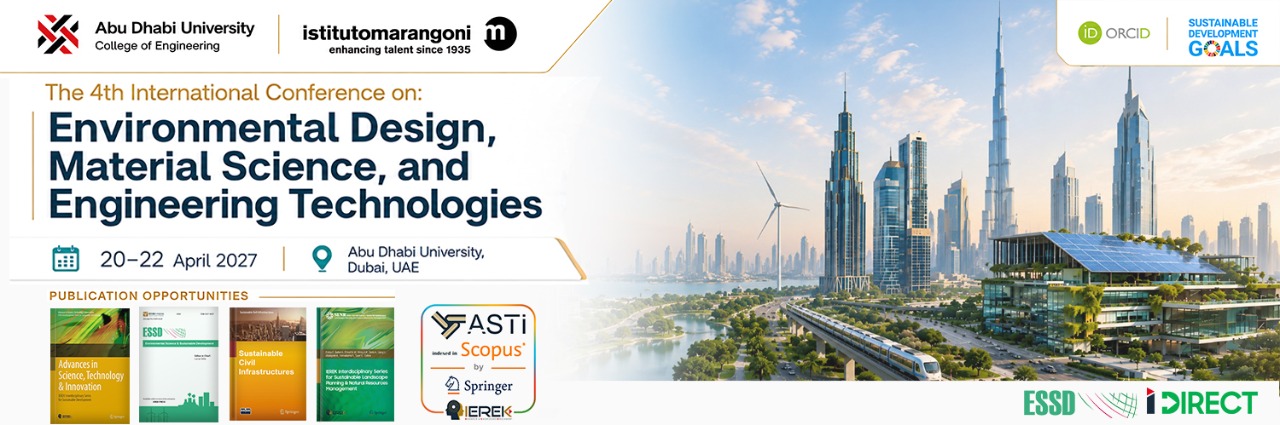
DEADLINE: 22 APRIL 2027 IN-PERSON & ONLINE

Conference Topics

1.1. Climate-Responsive Master Planning 1.2. Smart Cities and Technology Integration 1.3. Transit-Oriented Development (TOD) 1.4. Urban Heat Island (UHI) Mitigation 1.5. Smart Traffic Management Systems 1.6. Future Mobility and Autonomous Vehicles 1.7. Inclusive, Accessible, and Human-Centered Urban Design 1.8. Smart Governance and Urban Data Platforms 1.9. Climate Informatics and Urban Environmental Intelligence 1.10. Digital Carbon Accounting for Urban Systems

2.1. Bioclimatic and Passive Design Architecture 2.2. Net-Zero Energy Buildings (NZEB) 2.3. Biophilic Design and Environmental Psychology 2.4. Indoor Environmental Quality (IEQ) 2.5. Sustainable Interior Architecture and Furniture 2.6. Architectural Lighting and Environmental Acoustics 2.7. Adaptive Reuse and Sustainable Interior Retrofits 2.8. Smart and Connected Interior Spaces 2.9. Universal and Inclusive Interior Design 2.10. Healthy Buildings and Wellness-Centered Design

3.1. Digital Documentation and Restoration Technologies 3.2. Adaptive Reuse of Historic Buildings 3.3. Innovative Preservation Materials and Methods 3.4. Conservation Ethics and Legislative Frameworks 3.5. Cultural Sustainability in Urban Regeneration 3.6. Community Engagement in Heritage Management 3.7. Vernacular Architecture and Indigenous Building Knowledge 3.8. Structural Diagnosis and Monitoring of Historical Monuments 3.9. Climate Change Adaptation for Heritage Sites

4.1. Adaptive and Intelligent Structural Systems 4.2. Seismic Engineering and Structural Resilience 4.3. Sustainable Construction Practices in Structures 4.4. Advanced Infrastructure Materials 4.5. Structural Health Monitoring (SHM) 4.6. Predictive Analytics for Structural Life Extension 4.7. Climate-Resilient Infrastructure Design 4.8. Infrastructure Vulnerability Assessment

5.1. Robotics and Automation on Construction Sites 5.2. Large-Scale Additive Manufacturing (3D Printing) 5.3. Prefabrication and Modular Building Systems 5.4. Design for Disassembly (DfD) and Deconstruction 5.5. Life Cycle Assessment (LCA) of Built Assets 5.6. Advanced Building Information Modeling (BIM) 5.7. Construction Site Digitalization and IoT Monitoring 5.8. Construction Waste-to-Resource Technologies 5.9. Circular Supply Chains and Sustainable Material Procurement

6.1. Low-Carbon and Sustainable Cementitious Materials 6.2. Bio-Based Structural Composites 6.3. Smart Polymers and Responsive Functional Materials 6.4. Corrosion, Surface Chemistry, and Protective Coatings 6.5. Catalysis, Reaction Engineering, and Green Chemical Processes 6.6. Nanomaterials Synthesis, Characterization, and Applications 6.7. Recycled and Secondary Raw Materials in Structural Applications 6.8. Biomaterials and Bio-Inspired Material Engineering

7.1. Advanced Machining Processes and Precision Engineering 7.2. Automation, Robotics, and Intelligent Control Systems 7.3. Industrial Engineering & Process Optimization 7.4. Fluids & Thermal Engineering Optimization 7.5. Aerospace Engineering & Technology 7.6. Biomedical & Biotechnology Engineering 7.7. High-Performance Manufacturing Systems 7.8. Smart Factories and Industry 5.0 7.9. Sustainable Manufacturing and Resource Efficiency 7.10. Computational Fluid Dynamics (CFD) and Multi-Physics Simulation

8.1. Solar Energy Harvesting and Advanced Photovoltaics 8.2. Wind and Geothermal Energy Engineering 8.3. Energy Storage Innovations and Battery Technologies 8.4. Smart Grid Integration and Logistics 8.5. Sustainable Aviation Fuels (SAF) and Clean Hydrogen Infrastructure 8.6. Electrical Power Systems Optimization 8.7. Hydrogen Production, Storage, and Fuel Cell Systems 8.8. Small Modular Reactors (SMRs) and Advanced Nuclear Systems

9.1. Automation, Robotics, and Intelligent Control Systems 9.2. Smart Factories and Industry 5.0 9.3. Advanced Machining and Precision Engineering 9.4. Industrial Process Optimization and Lean Manufacturing 9.5. Sustainable Manufacturing and Resource Efficiency 9.6. Additive Manufacturing and Rapid Prototyping Systems 9.7. Supply Chain Resilience and Smart Logistics

10.1. Spatial Data Analysis and Geotechnical Mapping 10.2. Sustainable Subsurface Exploration and Drilling 10.3. Reservoir Engineering and Enhanced Recovery 10.4. Carbon Capture, Utilization, and Storage (CCUS) 10.5. Sustainable Mining and Minerals Processing 10.6. Petroleum Systems and Asset Integrity 10.7. Geological Hazard Assessment and Monitoring 10.8. Geo-Energy Systems and Underground Hydrogen Storage 10.9. Remote Sensing and Earth Observation Technologies

11.1. AI-Driven Material and Structural Optimization 11.2. Machine Learning Applications in Predictive Maintenance 11.3. Computer-Aided Engineering (CAE) and Simulation 11.4. Threat Modeling and Critical Infrastructure Cybersecurity 11.5. Secure Software Development Life Cycle (SDLC) 11.6. Ethical Considerations and Governance in Engineering AI 11.7. Edge AI and Embedded Intelligent Systems 11.8. Quantum Computing and Engineering Applications 11.9. Digital Twins and Intelligent Infrastructure Systems 11.10. Big Data Analytics and Decision Intelligence

12.1. Water Resource Engineering and Hydro-Conservation 12.2. Hydraulic and Sustainable Urban Drainage Systems (SUDS) 12.3. Ecosystem Conservation and Nature-Based Solutions 12.4. Carbon Footprint Management and Environmental Policy Frameworks 12.5. Environmental, Social, and Governance (ESG) Finance and Sustainable Economics 12.6. Smart Agriculture and Precision Farming Technologies 12.7. Food-Energy-Water Nexus Engineering 12.8. Humanitarian Engineering and Disaster Recovery Systems 12.9. Engineering Solutions for the Sustainable Development Goals (SDGs)

13.1. Occupational Health and Safety Management Systems 13.2. Ergonomics and Human Factors in Engineering Design 13.3. Risk Assessment and Mitigation Strategies 13.4. Innovations in Personal Protective Equipment (PPE) 13.5. Mental Health and Wellbeing in Engineering Work Environments 13.6. Emergency Response Planning and Crisis Management

14.1. Offshore Energy Solutions 14.2. Coastal Engineering and Flood Protection 14.3. Naval Architecture and Ship Powering 14.4. Port Infrastructure and Marine Logistics 14.5. Subsea Engineering and Pipeline Technology 14.6. The Blue Economy Innovation 14.7. Marine Environmental Monitoring Systems 14.8. Underwater Robotics and Autonomous Marine Vehicles 14.9. Coastal Smart Cities and Waterfront Resilience 14.10. Sustainable Fisheries and Ocean Resource Technologies